WIMP Interfaces
WIMP (Windows, Icons, Menus, Pointers) interfaces are the most common interfaces and they represent the first way that human designed the interaction with a computer in a more natural way, by using a GUI.
Remember that not always there is a natural way, since different cultures use different types of conventions, so we also need to take these into consideration.
Before WIMP there were punched-cards and terminal-based computers, which required more expertise and a lot of command memorization. WIMP interfaces changed that, and made human-computer interaction more intuitive by using visual elements that can be clicked, pointers that can be moved, windows that contained content and can me moved, and menus that can be expanded.
Remember that a user interface includes both hardware and software, since you need hardware parts to capture the signals and software to process them.
Post-WIMP Interfaces
Example of post-WIMP interfaces are:
- Touch-screens
- Gesture-based interfaces
- Haptic interfaces
- Voice user interfaces
- Natural interfaces
- Organic interfaces
- Kinetic interfaces
- Immersive interfaces
- Brain interfaces
Natural Interfaces
During human-to-human interaction, it’s not only the speech “channel” than conveys information, but also the tone of the voice, the expressions, the gestures etc. Because of this, people tried to invent new ways to communicate with a computer in order for the interaction to be more human-to-human-like. These types of interfaces are called Natural User Interfaces.
Natural UIs doesn’t mean that they are easier to use, since sometimes the interaction can be less precise than a more technical way of doing the same thing. Think about a gestural user interface, where gestures may not be recognized correctly, or maybe the pointing gesture may not be as precise as a standard mouse.
Expressions and gestures are so important in the communication that we can see that a person is lying by analyzing the micro expressions and the gestures they make
Here the term Natural User Interfaces, which are defined as interface When dealing with multimodal interfaces, the traditional WIMP interfaces, since they can still be the best way of interacting in some contexts.
A multimodal interface (that uses other channels of interaction like gestures, voice etc…) can enrich the interaction, in order for it to be more precise.
Organic Interfaces
A subcategory of natural user interfaces are organic interfaces, where we use everyday objects in order to interact with the system. This includes Tangible Interactive systems, or systems that are projected on everyday objects and make them interactive.
Implicit Interaction
We call implicit (or incidental) interaction the type of interaction which the user doesn’t explicitly need to make. A smart house that does something where the owner enters is an example. The explicit interaction equivalent would be the owner that flips the switch in order to explicitly turn on the lights.
The main problem of implicit interaction is obstruction, which means that the system does an action with the implicit command of the user, but it doesn’t mean that it’s what the user wants.
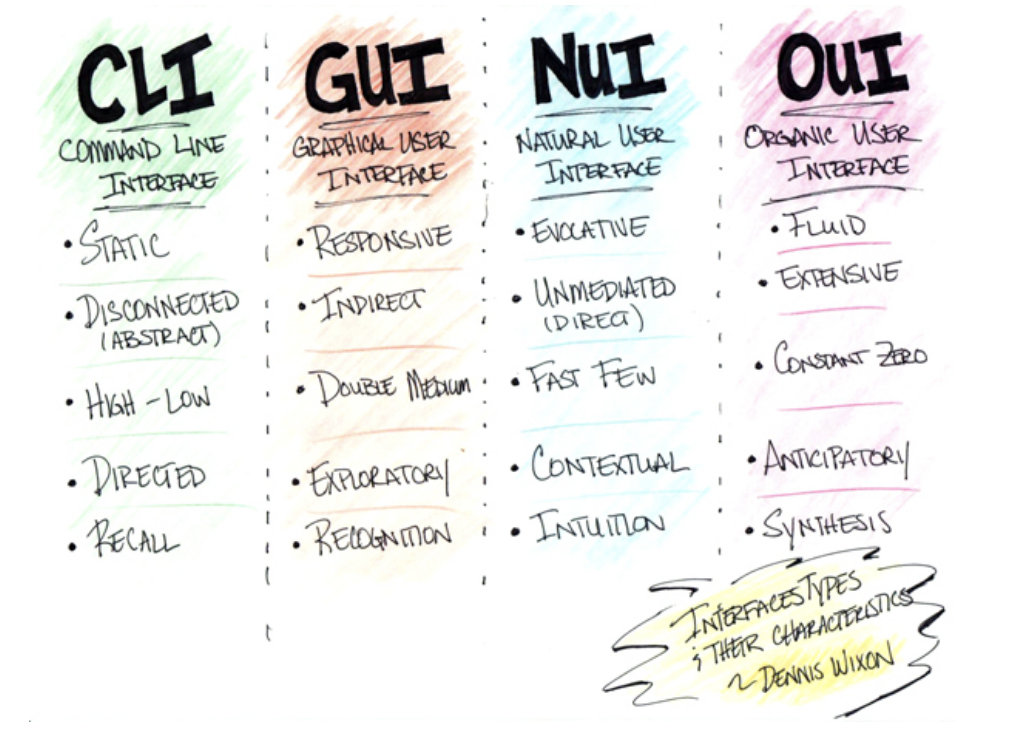 This is a scheme that shows the evolutions of interfaces.
tags: multimodal-interaction references: