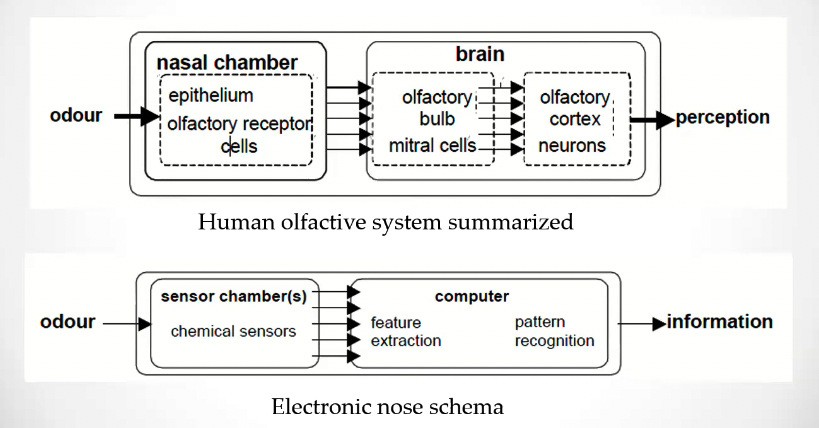
Electronic noses are devices that can detect the smell that a combination of molecules has.
RGB has million of combinations (number of colors) with just 3 channels and 256 values for each channel. Imagine how many combinations of smell can a molecule with a lot more channels and possible values can have.
An example of electronic noses are methane (and other dangerous gas) detection devices. These are essential since it’s not possible to have humans to check the presence of these gases.
Smell is a fundamental sense for animals in order to sense if danger is near, and because of this it has a very long range, much more than sight and hearing.
Predator arrive to the pray in the contrary direction of the wind, in order for the pray to not smell the predator.
Such as sight, where we are only able to see a particular spectrum of light, also for smell there is a particular spectrum that humans can perceive.
Different people can perceive smell more and less, with different sensitivities. Sensitive and trained people are able to identify each different part that creates some types of odours.
Terminology
- Odour: a property or a quality of a thing that stimulates or that it’s perceived by the sense of smell.
- Odorants: volatile chemical substances which come from an object and that provoke the odour.
VOD - Virtual Olfactory Display
A Virtual olfactory display (VOD) is a system (a type of transducer in particular) made of hardware, software and chemicals that are able to present olfactory information to the user.
Usually it transduces the information from the electronic domain to the chemical domain. It basically reproduces an odour from a virtual information (chemicals are like ink in a printer, and the software controls the amount of different chemicals to mix in order to create a specific odour). They are also called odour generators.
 Saturation is the phenomenon in which if a person’s sense is constantly exposed with the same signal, then the sense will slowly stop perceiving that particular signal. This happens for smells (if we’re constantly in a room that has a certain smell, we’ll not perceive it anymore after some time), and also for sight (we don’t see our nose).
Odours perceived by humans can also be infected, meaning that stronger odours can cover lighter ones.
Electronic noses don’t suffer from saturation, since they’re electronic devices, Virtual Olfactory Displays, on the other hand, have to take saturation into account.
They also need to take into account odour interference (when a presented odour can infect another odour); persistence (how much does an odour last before fading away) and smell field (a human can locate the source of a small with an error of 7-10 degrees, that’s why the VOD should place the odour in a sufficient smell field.)
Teleolfaction
Teleolfaction is a form of virtual olfaction and means smelling a mixture of odourants whose composition is related to a mixture present in a remote place. It basically copies odours from a remote place, maintaining an high fidelity.
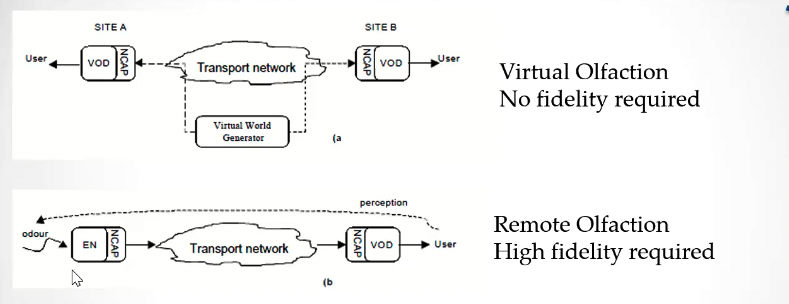
The remote odour gets captured by an electronic nose, which digitalized it. The signal is the transmitted to the other location, gets captured by the virtual olfactory display which converts it back to the most similar odour by combining the chemicals.
Virtual olfaction doesn’t require fidelity since the original odour comes directly from a digital information.
Virtual Flavours
A flavour is influenced by basically all the senses, taste of course and also a lot of smell, including also the other senses.
Differently from visual interfaces, where we don’t need to produce anything but only show images to convey the information, with flavours it’s different, since we need to a chemical dispenser that produces molecules which need to touch the tongue of the subject in order for the taste to be sensed.
With brain interfaces, we might be able to virtually simulate the odour (or flavour) by only using brain stimuli.
As odours, the taste of possible flavours is very broad, but a study was done in order to replicate a good range of flavour with only a combination of 20 flavouring agents. Of course the range is still very limited with respect to the real range.
tags: multimodal-interaction