In the context of automata theory, a timed automata is a finite state machine extended with a finite set of real-valued clock, which is used to model the behavior of the system components over time.
The transitions are labeled with a guard which determines the condition on the clocks in order to change the state; a word that has to be read, and a set of clocks to reset when transitioning.
The state of a timed automata is a pair composed by a location node and a clock assignment.
The automata below accepts the alphabet , and:
- The transition from to happens when the letter is read, and it resets the clock (indicated by the clock reset );
- The self-loop in happens when we the letter is read, and it doesn’t change the state of the clocks.
- The transition from to happens when the letter is read and when the clock constraint is satisfied. It doesn’t change the state of the clocks.
- The self-loop in happens when we the letter is read, and it doesn’t change the state of the clocks.
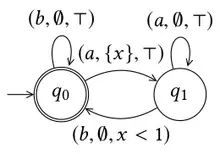 The timed automata we just described recognizes words over the alphabet where each occurrence of is followed by an occurrence of after less than a time unit (because the clock condition ).
tag: automata