- Description: Bell-shaped curve symmetric around the mean. Arises in many natural processes due to the Central Limit Theorem.
- Parameter(s): - : mean - : variance
- Use Case: Heights, weights, financial returns (rough approximation).
- Properties: 68-95-99.7 rule for 1, 2, 3 standard deviations.
The normal distribution’s formula is:
Why is the formula like this?
- : The function describes exponential growth, and by making the exponent negative it describes an exponential decay. To make this decay in both directions, you need to make sure that the exponent is always negative, for example by squaring it or by taking the absolute value . This gives us the classic bell curve shape.
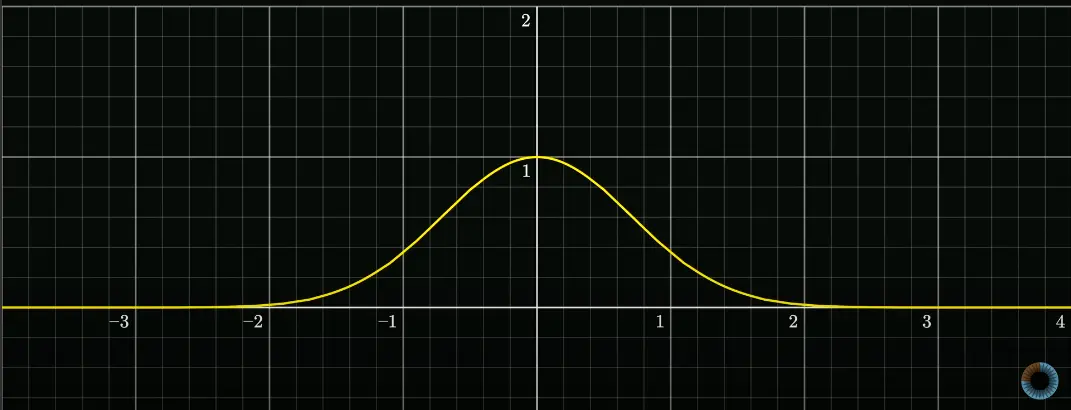
- If we add a constant in front of the exponent , we can describe more narrow or wider bell curves.
- Since the area under the entire bell curve represents the probability of something happening, it should be 1. If we just represent the bell curve as , then the area is , so to have an area of we can just use .
- We can reformulate the entire thing as in order for to represent the standard deviation of the curve, but in this way we will have an area of , that’s why we also divide by that, obtaining the formula:
- We can also subtract the mean from the in order to be able to center the bell curve around any mean, and not always in the .
statistics resources:
- But what is the Central Limit Theorem? - YouTube (from min 16:00)